Solos’ New Smart Glasses Let You Physically Block the Camera
Smart glasses maker Solos has built its reputation on audio-only eyewear, but its latest release shows the company is ready to compete more directly in the camera-equipped segment of the market — while trying to address one of the biggest concerns people have about wearable cameras.
Meet the AirGo A6 and AirGo V2
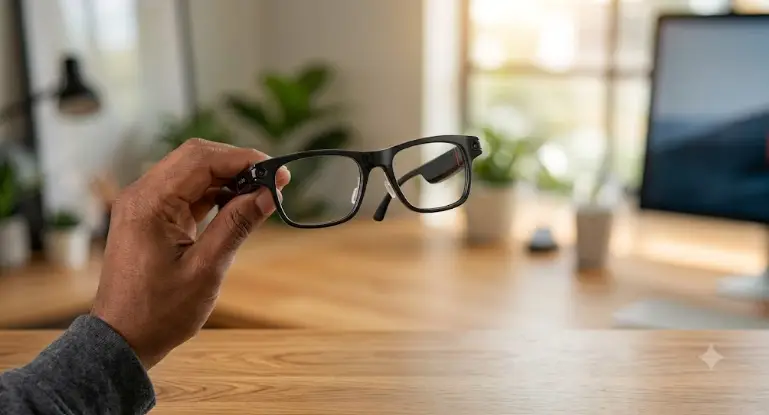
Solos introduced a pair of new smart glasses this week. The AirGo A6 sticks to the brand’s audio-first roots and skips a camera entirely. The AirGo V2, on the other hand, is the company’s second attempt at camera-equipped smart glasses, following up on a model that was originally pitched as a rival to Meta’s popular smart glasses lineup.
Priced at $299 — the same as Meta’s current smart glasses — the AirGo V2 covers most of the same ground: it can snap photos, record video, play music, and work with an AI assistant capable of interpreting what the wearer is looking at. The frames also support prescription lenses and are rated for roughly 10 to 12 hours of continuous use on a single charge.
What’s Inside the Privacy Kit
The standout feature isn’t the camera itself — it’s the optional Privacy Kit, a modular set of clip-on attachments designed to give wearers more control over when the camera can actually see anything. One piece in the kit is a physical shield that clips over the lens, blocking it from capturing photos or video and effectively switching the glasses into an audio-only mode. The kit also includes a clip-on polarized lens option. Buying the full set costs an additional $79 on top of the glasses themselves.
It’s a clever idea on paper, but the execution raises a few questions. Needing to purchase a separate accessory, then physically attach and remove it every time you want to toggle the camera on or off, adds friction that could discourage most people from bothering at all. There’s also nothing technically preventing someone from taking the shield off partway through a conversation or after entering a space where recording isn’t allowed — the privacy protection depends entirely on the wearer choosing to use it.
How Solos’ Earlier Glasses Were Received
This isn’t Solos’ first attempt at a camera-equipped pair. The original Solos AirGo Vision launched back in 2024 and received a lukewarm response from reviewers, who pointed to inconsistent photo and video quality, clunky touch-based controls, and a companion app that requested more device permissions than felt necessary. Overall, that earlier model fell short of the bar Meta had already set in the category.
A Crowded Market, Dominated by Meta
Meta remains the clear leader in smart glasses, but competition is building from multiple directions. Google and Samsung are collaborating on the Android XR platform, with new hardware expected later this year from eyewear brands including Warby Parker and Gentle Monster. Apple is also reported to be developing its own smart glasses.
Meanwhile, smaller players are staking out different territory. Even Realities, for instance, has built its entire pitch around glasses that skip cameras altogether. Solos appears to be following a similar instinct with its renewed focus on privacy — timing that lines up with a rough stretch of publicity for Meta’s own glasses.
Meta’s smart glasses have faced repeated criticism, including being labeled unsettling “creep” devices by some critics, and drew backlash after reports surfaced that the company had quietly built facial recognition capability into the glasses before removing it following public pressure. More recently, Meta announced plans to start charging for certain features on its smart glasses that used to be included for free, adding to the friction with its user base.
Interestingly, even Meta’s own leadership has acknowledged demand for audio-only wearables. In informal comments to reporters, Meta CTO Andrew Bosworth indicated he believes there’s genuine market interest in that kind of product. Meta hasn’t shifted its main lineup away from camera-first glasses, though it’s possible an audio-only option could arrive down the line. For now, that gap in the market is exactly where companies like Solos are trying to gain ground.
Solos AirGo V2 — Full Specifications
| Spec | Details |
|---|---|
| Lenses | Non-prescription lenses that filter UV rays and high-energy blue light, with an anti-glare coating |
| Hinge | V2 hinge design |
| Notification LED | Yes |
| Photo capture | Yes |
| Video recording | Yes |
| Image resolution | 16MP photos, 2K FHD video |
| ChatGPT | login Personal ChatGPT account login not supported |
| Frame shape | Rectangular |
| Material | TR90 |
| Compatible OS | Android and iOS |
| Bluetooth | BT 5.2 with BLE |
| Bluetooth range | ~33 ft in open space |
| Battery life | ~16 hours of photo capture and AI queries |
| Standby time | Up to 5 days |
| Fast charge | 15 minutes for ~3 hours of use |
| Full charge time | ~1.5 hours |
| Water resistance | IP54 |
Should You Wait for These or Buy Now?
If camera-based privacy is your main concern, the Privacy Kit is a nice option to have — but it’s worth going in with realistic expectations about how much it actually solves. For buyers who care most about audio-only functionality, the AirGo A6 might be the simpler, more privacy-forward choice from the start. Either way, Solos is clearly positioning itself as an alternative for people who want smart glasses without fully committing to an always-camera-ready device.