Haier M70 Mini LED TV (65-Inch) Review: The Budget Mini LED That Wins on Sound, Not Just Screen
Haier’s M70 series proves you don’t need a premium price tag to get Dolby Vision, Mini LED, and genuinely loud built-in audio — but a few compromises keep it from being a clean sweep.
I’ve tested enough sub-$790.10 TVs to walk in with low expectations for audio. Most budget and mid-range sets treat sound as an afterthought, packed into thin speakers that get drowned out the moment you turn on a movie. The Haier M70 Mini LED TV broke that pattern almost immediately, and that surprise ended up shaping how I feel about the whole package. Here’s my full breakdown after spending real time with the 65-inch model.
Pricing and Positioning
Haier’s M70 Mini LED lineup starts at Rs. 39,190 for the smallest 43-inch model and scales up to an 85-inch flagship. My review unit sits in the middle of that range: the 65-inch variant, priced at Rs. 74,999. At that price, Haier goes up directly against the Xiaomi S Mini LED and the newer Lumio Vision 9, both chasing the same budget-conscious buyer who wants Mini LED technology without a premium-brand markup.
Design: A Unibody Build That Doesn’t Feel Cheap
Haier clearly wanted this TV to look and feel more expensive than its price suggests, and it mostly succeeds. The unibody construction keeps bezels slim and hides seams you’d normally spot on a budget set. Out of the box, the build quality genuinely surprised me — this doesn’t feel like a corner-cutting TV.
The 65-inch panel measures 1445mm x 76mm x 836mm without the stand and weighs 16.4kg. Two included stands hold it securely, but given the size and weight, I’d recommend wall mounting if your setup allows it — you won’t want to reposition this TV often.
Port placement earns a small but appreciated design win. Haier keeps every connectivity port on the left side and routes the power cable to the right, which makes cable management noticeably cleaner than TVs that scatter ports across the back panel. You get three HDMI ports (one with eARC support), two USB ports, an Ethernet port, a mini AV port, an optical audio port, a 3.5mm jack, and dual antenna inputs. I also noticed a dedicated subwoofer cutout at the rear centre — a small detail that hints at how seriously Haier treated the audio engineering.
Display: Where This TV Earns Its Price Tag
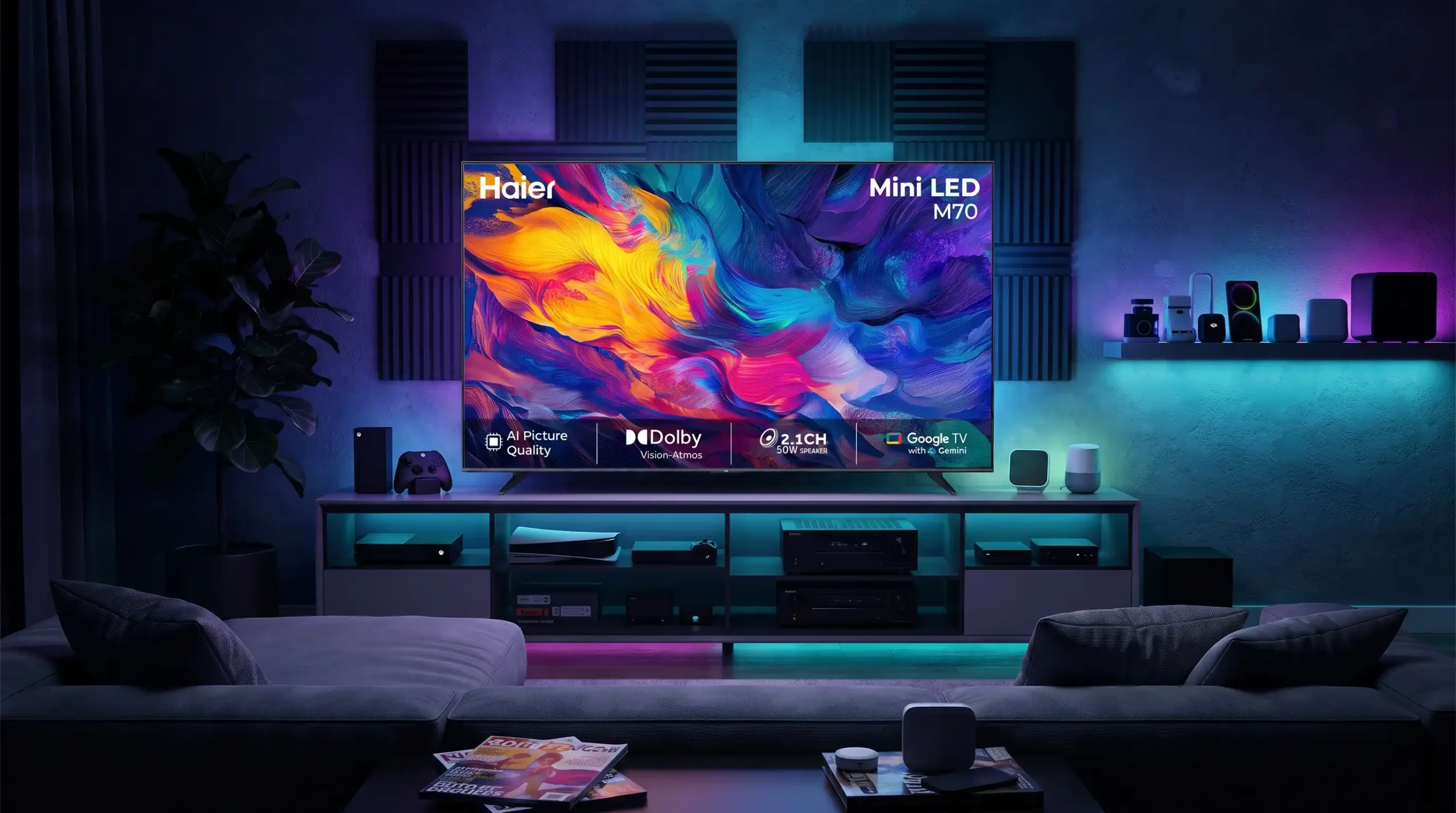
The core spec sheet reads well for the money: a 65-inch 4K Mini LED panel at 3840×2160 resolution, D-LED backlighting with micro-dimming, HDR10+, Dolby Vision, a 120Hz DLG refresh mode, and a 93% DCI-P3 colour gamut. Micro-dimming splits the panel into multiple zones and adjusts brightness and black levels independently per zone, and that’s exactly what separates a Mini LED panel from a standard direct-lit LED TV.
In practice, the picture delivers. I watched several anime titles, and colours came through punchy and vibrant without looking oversaturated. Dark scenes in Operation Safeed Sagar on Netflix held their detail well, with blacks that stayed deep rather than crushing into grey. Switching to F1: The Movie on Apple TV let me test motion handling directly, and the combination of MEMC and ALLM kept fast racing sequences smooth without noticeable judder.
Haier’s AI Picture Quality mode runs quietly in the background, adjusting HDR enhancement, colour boost, motion smoothing, and noise reduction based on what’s on screen. I left it enabled throughout testing and never felt it interfering with the picture in an obvious way, which is exactly how this kind of feature should behave.
My one real complaint here is brightness. Peak output tops out around 320 nits, which falls short of what I’d want for a genuinely punchy HDR experience, especially in a bright room. If you’re watching in a dim living room or home theatre setup, this won’t bother you much. In daylight-heavy spaces, you’ll notice the ceiling.
Software and Performance: Familiar, With a Gemini Twist
The M70 runs Google TV on Android 14, and Haier bundles Gemini directly into the experience. I used it mainly for hands-free app launching and quick info lookups, and it worked reliably without feeling gimmicky. If you already use Google TV on another device, you’ll feel instantly at home here — the interface doesn’t reinvent anything.
Hardware-wise, you get 2GB of RAM and 32GB of storage. Navigation felt smooth for everyday use — browsing menus, launching apps, switching inputs. Push it harder with heavy multitasking, though, and you’ll notice input lag creep in. The 32GB of storage is a genuine plus at this price point, since it lets you install a wider spread of streaming and gaming apps without immediately running out of space.
Gaming Features That Punch Above the Price
Haier didn’t treat gaming as an afterthought here, which I didn’t expect at this price. The Gaming Bar gives you quick picture-mode switching tailored to FPS, RTS, and RPG genres, plus a Shadow Enhancement mode that brightens dark areas and a Crosshair Assist overlay for shooters. You can also toggle between 4K at 60Hz and 1080p at 120Hz with DLG support, depending on whether you prioritize resolution or responsiveness.
None of these features will replace a dedicated gaming monitor, but for a living-room console setup, they add real value that most TVs in this price bracket skip entirely.
Audio: The Genuine Standout
This is where the Haier M70 separates itself from the pack. The 2.1-channel setup pushes 50W total output through a built-in subwoofer tuned with input from Total Sonics, and it carries Dolby Atmos certification. I ran a mix of movies and music through it, and the bass depth genuinely surprised me — this is audio that fills a medium-sized room without sounding thin or tinny, a problem that plagues most integrated TV speakers at this price.
The remote rounds out the package with a compact, metallic finish and sensibly placed controls, including volume and mute conveniently positioned on the right side.
Verdict: A Strong Mini LED Pick With One Clear Trade-Off
The Haier M70 Mini LED TV makes a compelling case for itself in the sub-Rs. 75,000 bracket. The unibody design looks and feels more premium than the price suggests, the Mini LED panel delivers genuinely strong contrast and color accuracy, and Google TV with Gemini keeps day-to-day use intuitive. The audio, though, is the real headline — I didn’t expect a TV at this price to sound this good.
The trade-offs are real but manageable. Peak brightness at 320 nits limits HDR impact in bright rooms, and 2GB of RAM shows its limits under heavy multitasking. Weighed against the competition — the Xiaomi S Mini LED and the Lumio Vision 9 (2026) chief among them — the M70 holds its own, particularly for anyone who values sound quality as much as picture quality. If that’s your priority, this is one of the more interesting Mini LED options at this price right now.