iPhone Duo Review: Our Hands-On First Look at Apple’s First Foldable Phone
Apple finally joined the foldable phone race. The company unveiled the iPhone Duo at its Cupertino event, alongside the iPhone 18 Pro and Pro Max. We spent time with the device shortly after the announcement, and this hands-on breaks down what actually stands out — the build, the cameras, the battery, and where it fits against Samsung’s Galaxy Z Fold 8.
Apple will release the iPhone Duo on October 23. Preorders open October 16. The price starts at $1,999 for the 256GB model. That price places the Duo firmly in premium territory, above even the iPhone 18 Pro Max.
What Is the iPhone Duo?
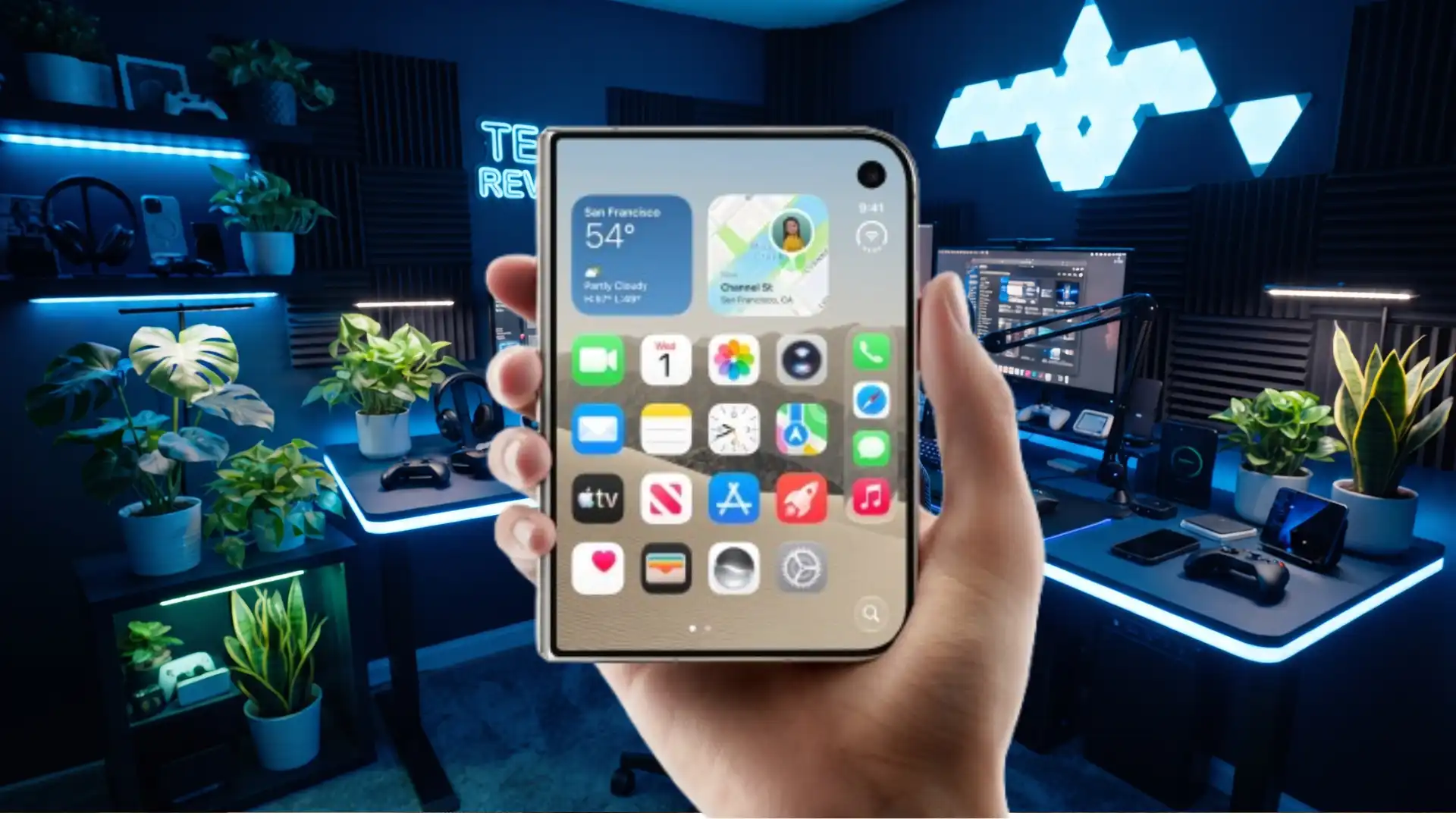
The iPhone Duo is Apple’s first book-style foldable. It opens into a 7.6-inch inner display and closes down to a 5.4-inch cover screen. Think of it as a phone that unfolds into a small tablet. You can watch video, read, or multitask on the large inner screen, then fold it shut for one-handed use like a normal iPhone.
This launch matters beyond specs. It’s Apple’s biggest hardware shift in years, and it signals that the company sees folding screens as more than a niche experiment. Samsung, Google, Honor, and Huawei already sell folding phones. Apple now enters that field directly.
Design and Build Quality
The Duo feels compact in hand. Its closed shape resembles a passport, and its dimensions sit close to the Galaxy Z Fold 8. Apple built the frame from titanium, which keeps the weight at 254 grams despite the dual-screen design.
Open, the Duo measures just 5.2mm thick — Apple’s thinnest iPhone yet. Closed, it reaches 11.3mm. The hinge uses more than 100 components, and it delivers a smooth, tight motion when opening and closing.
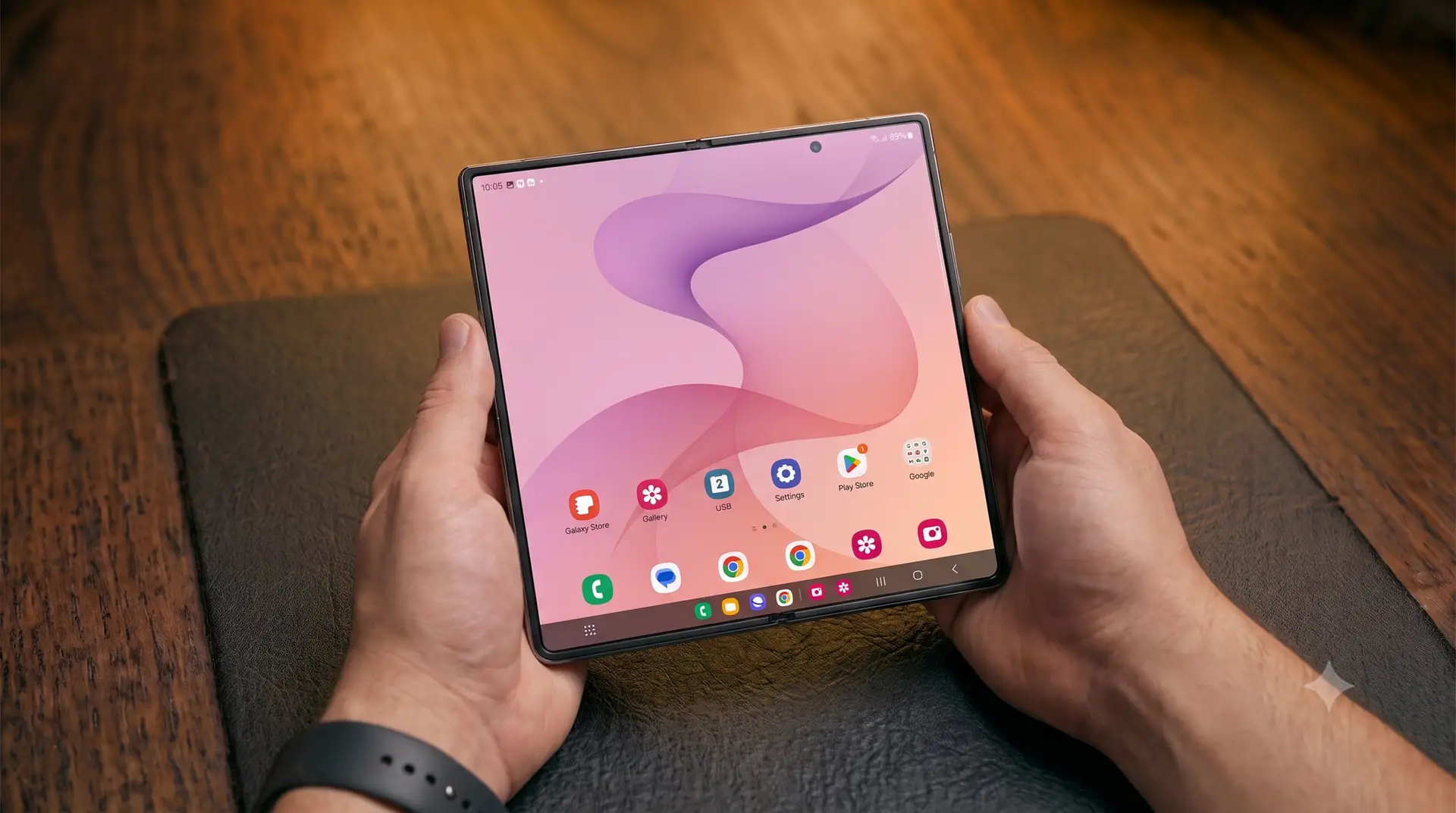
Apple gave the inner display a matte, nano-texture finish. This coating cuts glare and visibly softens the crease down the middle of the screen. In our brief testing, the crease looked less noticeable than on the Z Fold 8, even though Samsung also uses an anti-reflective layer. Samsung’s design still uses sharper, more angular edges, while the Duo leans rounder. That distinction comes down to taste rather than performance.
One clever software touch: content shifts from the cover screen to the main display almost instantly when you open the phone. Samsung’s Z Fold 8 waits until the phone reaches roughly the halfway point before switching screens. It’s a small detail, but it makes the Duo feel more polished during everyday use.
Apple placed the volume buttons along the top edge in landscape orientation. That keeps them separate from the lock button and Camera Control, though it takes a few days to build the muscle memory. The upside shows up in portrait mode, where the placement becomes far more natural.
Durability holds up well too. The Duo carries an IP68 rating for dust and water resistance, matching the Google Pixel 11 Pro Fold. Ceramic Shield 2 covers the front, and Ceramic Shield protects the back, backed by an internal titanium plate.
Display and Software Experience
Both screens on the Duo share the same aspect ratio. That consistency means apps and photos scale cleanly between the cover and inner display, instead of stretching or cropping awkwardly.
The inner 7.6-inch screen suits video, gaming, and split-screen multitasking. Apple currently limits multitasking to two apps at once. Samsung’s Z Fold 8 supports three, though we find three apps often feel cramped on a 7.6-inch panel anyway.
Apple Pencil support gives the Duo an edge here. The Z Fold 8 doesn’t support Samsung’s S Pen, so stylus users now have a real reason to consider Apple’s foldable over Samsung’s.
Touch ID handles authentication instead of Face ID. That choice feels like a step backward on a phone at this price. Still, many foldable owners already default to fingerprint unlock, since face unlock can behave inconsistently when a phone opens at odd angles.
Under the hood, the A20 Pro chip powers the Duo — the same chip found in the iPhone 18 Pro line. Performance should match Apple’s flagship phones, without added lag from the second display.
Camera System
The iPhone Duo ships with two rear cameras: a 48-megapixel main sensor and a 48-megapixel ultrawide. Apple skipped a telephoto lens entirely, matching Samsung’s approach on the Z Fold 8. Photographers who lean on zoom shots may miss that lens, but casual shooters likely won’t notice the gap.
Video capabilities land closer to flagship territory. The Duo records 4K video at 120 frames per second in Dolby Vision, plus 4K time-lapse in Dolby Vision HDR.
A few foldable-specific camera features stand out:
- Dual Capture lets FaceTime users record with the front and rear cameras at the same time.
- Duo Preview shows subjects a live preview on the cover screen while someone shoots with the rear camera.
- Kid Cue plays Peanuts animations on the cover screen to hold a child’s attention during photos — Apple’s answer to the “Made You Look” feature on Google’s Pixel foldables.
Battery Life and Charging
Apple rates the Duo for up to 31 hours of video playback using the inner display, or 44 hours on the outer screen alone. Mixed use of both screens brings that down to roughly 24 hours.
Real-world battery life will likely land closer to that 24-hour figure for most owners, since foldable users tend to switch between both displays throughout the day. We’ll confirm exact numbers once we run the phone through full battery benchmarks.
Charging speeds keep pace with expectations. A 60-watt (or higher) wired charger reaches 50% in about 20 minutes. A MagSafe or Qi2 wireless charger hits the same 50% mark in around 30 minutes.
iPhone Duo vs. Galaxy Z Fold 8
Here’s how the two flagship foldables compare on paper:
| Feature | iPhone Duo | Galaxy Z Fold 8 |
|---|---|---|
| Inner display | 7.6 inches | 7.6 inches |
| Cover display | 5.4 inches | 5.5 inches |
| Multitasking | 2 apps | Up to 3 apps |
| Stylus support | Apple Pencil | None |
| Water/dust rating | IP68 | IP68 |
| Unlock method | Touch ID | Fingerprint/Face |
| Starting price | $1,999 | Varies by market |
Both phones target the same audience: people who want tablet-size media consumption in a pocketable shell. Apple’s edge shows up in stylus support and screen-transition smoothness. Samsung still wins on multitasking flexibility and, for now, a more established software ecosystem built specifically for folding screens.
Why the iPhone Duo Matters for the Foldable Market
Apple’s entry could reshape the broader foldable category, which has stayed a niche corner of the smartphone market for years. Industry analysts expect global foldable shipments to grow by more than 12% this year, with Apple’s launch driving a meaningful share of that growth. Some forecasts even project Apple shipping over 17 million foldable iPhones by 2027, which would translate to close to 40% of the global foldable market.
That kind of shift makes sense. Apple has a long track record of entering existing product categories late and still pulling significant market share through ecosystem lock-in, brand trust, and retail reach. Whether the Duo repeats that pattern depends on how the software experience holds up over months of daily use, not just a hands-on demo.
Should You Buy the iPhone Duo?
The iPhone Duo makes the most sense for people already inside the Apple ecosystem who want a bigger screen without carrying an iPad. Apple Pencil support, tight iOS integration, and Apple’s usual camera processing all favor loyal iPhone users.
Buyers who value maximum multitasking flexibility, Face ID, or a slightly larger cover screen may still prefer the Galaxy Z Fold 8. And at $1,999, this remains a purchase for early adopters and power users rather than an everyday upgrade pick.
Quick Verdict
| Specification | Rating (1–10) |
|---|---|
| Design & Build Quality | 9 |
| Display Quality | 9 |
| Performance (A20 Pro) | 9 |
| Camera System | 7 |
| Battery Life | 7 |
| Software & Multitasking | 7 |
| Value for Money | 6 |
| Overall Score | 8 |
Pros and Cons
Pros
- Thinnest iPhone Apple has ever built when unfolded
- Nano-texture display noticeably reduces glare and crease visibility
- IP68 water and dust resistance, rare for a foldable
- Apple Pencil support, unlike the Galaxy Z Fold 8
- Fast, seamless screen-to-screen content transition
Cons
- Touch ID instead of Face ID feels dated at this price
- No telephoto camera lens
- Multitasking limited to two apps at a time
- $1,999 starting price puts it out of reach for most buyers
- Battery life likely drops closer to 24 hours with mixed-screen use